
Is your earthing working all year long, or only when the ground is wet?
Are you concerned that your earthing might fail during dry summer months?
Looking for a natural, long-lasting way to keep your earthing strong?
If you answered yes to any of these, you are not alone. A good earthing system protects people, equipment, and buildings from electrical faults. One of the most effective ways to make earthing reliable is by using Bentonite Powder.
In this guide, you will learn how to use Bentonite Powder for electrical earthing, how much you need, the right installation steps, and why it has become the preferred choice for electrical engineers and contractors across India.
Why This Matters
Think about your earthing rod. It sits in the ground, buried deep. When electricity leaks from a wire or a machine, it comes to this rod. The rod pushes it down into the wet soil below. The wet soil lets it go all the way down where it is safe. Nobody gets hurt.
But what happens in summer? The ground around your rod dries completely. Dry soil does not let electricity pass through easily. When electricity tries to move through dry soil, it gets stuck. It does not go down into the ground safely. It stays on the surface instead. If a person touches it, they get a bad shock.
This is what bentonite fixes. It keeps the soil wet. Electricity moves through easily. People stay safe.
Why do big metro projects use it? Delhi Metro uses bentonite. Jaipur Metro uses it. Ahmedabad Metro uses it. They cannot take the risk of earthing that fails in summer. So they use bentonite powder.
Benefits of Using Bentonite Powder for Earthing
What do you get when you use bentonite? Here is what works.
Stays Wet All Year Bentonite holds water many times its own weight. Even when summer dries the ground, bentonite stays moist. Your earthing stays strong in every season.
Lower Resistance Earthing works better when soil resistance is low. Bentonite makes this happen by keeping soil conductive. Your earthing measurement stays below 5 all year.
Long-Lasting Does bentonite break down like chemical compounds? No. It works for decades with almost no maintenance. Once installed correctly, you forget about it.
Natural and Safe Is bentonite harmful? No. It is a natural mineral. It does not poison the soil or groundwater. Safe for the environment. Safe for people.
Cost-Effective Do you need frequent replacement? No. One installation lasts many years. This saves money in the long run.
How Much Bentonite to Use
How much do you need? It depends on what your soil is like.
Sandy soil? It is like powder. Water runs right through it. It does not hold water at all. So use more bentonite around your rod. About 12 to 15 kilos.
Clay soil? It is like mud. Water stays in it. It holds moisture naturally. So use less bentonite. About 8 to 10 kilos.
Mixed soil with rocks? Use somewhere in between. About 10 to 12 kilos.
Not sure what soil you have? Ask your supplier. They will look at it and tell you what amount makes sense.
How to Install Bentonite Powder
Installation is simple. Here is what you do.
First, dig a hole around your earthing rod. Make it about 1 meter wide and 1 meter deep. This gives you space to work around the rod.
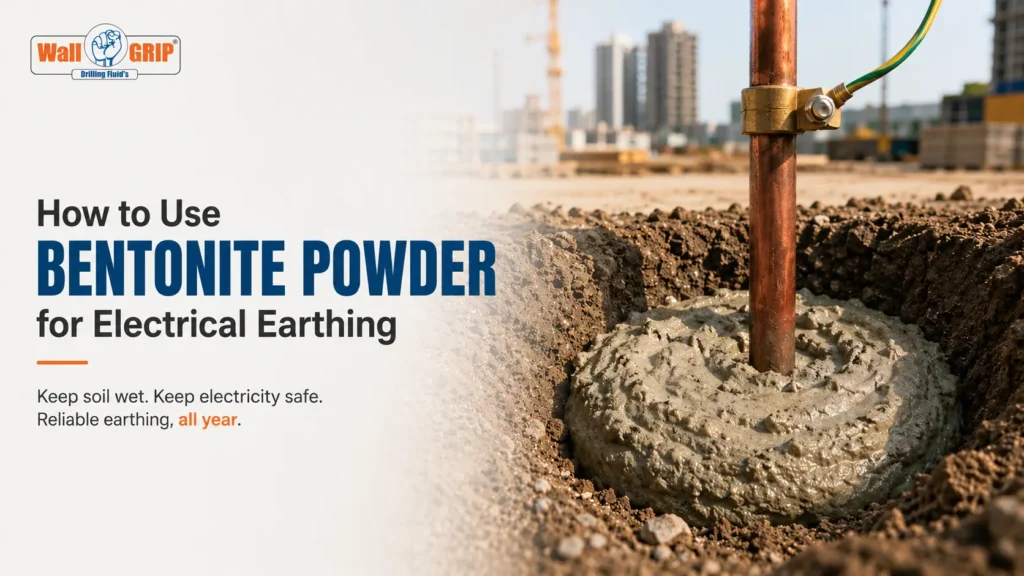
Second, pour the bentonite powder into the hole. Keep it dry at this stage.
Third, add water slowly and mix it with your hands or a stick. What are you making? Paste. Like cement paste. Not like water. Not like dry powder. Something thick that holds together. Why does this matter? If you just pour water without mixing, the powder makes hard lumps. Inside those lumps, the powder stays dry. Dry powder does not help anyone. You want smooth, thick paste that binds together.
Fourth, push this paste hard around the rod. Use your hands or a stick to pack it down tight. Make sure there are no holes or gaps. Why? Because gaps mean dry spots stay inside. Dry spots ruin everything.
Fifth, fill the hole with normal soil and pack it down layer by layer. The bentonite stays underground. There it keeps the ground wet for many years.
Use Sodium Bentonite, Not Calcium
There are two types of bentonite. They look similar. But they are very different.
Sodium bentonite? Think of it like a sponge. When you add water, it gets huge. It swells 12 to 15 times its size. Imagine a small sponge becoming enormous. That is what sodium bentonite does. This size is what keeps soil wet. This is why it works for earthing.
Calcium bentonite? It is like a cloth. When you add water, it gets a little bigger. Maybe 2 to 3 times its size. A small sponge gets slightly bigger. That is not enough. The soil around your rod does not stay wet enough for earthing. It just does not work.
Does calcium bentonite have uses? Sure. Companies use it in face cream. They use it in other products. But for earthing? It is useless.
What should you buy? Sodium Bentonite. Always. Check the bag or the paper. It must say “Sodium Bentonite” on it. Do not guess.
Bentonite Powder vs Other Earthing Materials
Can you use charcoal or salt instead of bentonite? Many people ask this. Here is how they compare:
| What Matters | Bentonite Powder | Charcoal & Salt |
| Holds Water | Excellent. Keeps soil wet for years. | Moderate. Dries out quickly. |
| Helps Electricity Move | Strong. Soil stays conductive. | Moderate. Works for some time. |
| Safe for Environment | Yes. Natural minerals. Does not harm soil. | No. Salt can damage soil over time. |
| How Much Care needed | Low. Works for decades with no maintenance. | High. Needs replacement every few years. |
| Long-Term Reliability | Excellent. Proven to last 20+ years. | Moderate. Degrades over time. |
| Will It Rust the Rod | No. Bentonite is safe for metal. | Yes. Charcoal and salt can corrode metal. |
Which is better for earthing that lasts? Bentonite Powder. Other materials are cheaper at first. But they cost more in the long run because you need replacement and maintenance.
Mistakes People Make
What goes wrong? Site engineers have told us. Here are the common mistakes.
Mistake 1: Wrong Type of Bentonite They buy Calcium Bentonite by accident. They think all bentonite is the same. It is not. Calcium bentonite does not swell enough. The soil does not stay wet. Earthing stays broken.
Mistake 2: Dry Installation They dump dry bentonite powder into the hole without mixing with water. Dry powder sits there doing nothing. It does not reach the soil properly. What should they do? Mix it with water first to make a paste.
Mistake 3: Wrong Timing They install during heavy monsoon rain. The rain washes the bentonite powder away or makes it very thin and weak. When should they install? Just before monsoon starts, or right at the beginning when the soil is naturally damp.
Mistake 4: No Testing They think once it is installed, it works. They do not test it. What should they do? Test your earthing 2 to 4 weeks after installation. Use a small device called an earthing tester. Connect it to your rod. The tester shows a number. If the number is below 5, electricity moves through easily and your earthing works. If the number is higher than 5, the bentonite did not get wet properly. You must dig it up and fix it.
How Long Does Bentonite Powder Last
How long does bentonite work? For decades. Maybe forever. Why? Underground there is always some water. Bentonite never dies completely.
What happens in summer? The ground dries out. The bentonite becomes less wet. The measurement goes up a little. Is this bad? No. This is normal. Do not worry.
What happens in the monsoon? Rain comes. The ground gets wet again. The bentonite absorbs this water and swells again. The measurement goes down again. This cycle repeats every year. Is this a problem? No. It is fine.
What should you do? Test your earthing every year after summer ends. The measurement should stay below 5. If it is still high after the monsoon comes and the ground is wet again, then something is wrong with how you installed it. Then you need to dig it up and check. Otherwise? Leave it alone. Good bentonite installed correctly needs no attention.
Indian Standards
What are the rules in India for earthing? India has standards. The rule says your earthing measurement should stay below 5 (explained in the 4th mistake).
When you buy bentonite powder, suppliers have papers. What papers? Papers that show what is inside the bentonite. Ask them to show you. What should the papers say?
The bentonite has 85 percent or more of something called montmorillonite. This is the real working part.
Good earthing bentonite has a swelling index of at least 24 ml per 2 g, which means it swells well when water is added.
These numbers mean the bentonite will actually work for your earthing.
FAQs
Question: Can I use bentonite for both piling and earthing?
Answer: Yes. Sodium bentonite works for both. What matters? That it is good quality.
Question: How deep should bentonite go?
Answer: Put it at the same depth as your rod. If the rod is 2 meters down, put bentonite 2 meters down. What about deeper? Even better. Water stays deeper in the ground longer.
Question: Will it work in very dry soil?
Answer: Yes. That is exactly the whole point. Very dry soil? That is when you need bentonite most.
Question: Will it work if there are rocks in the ground?
Answer: Yes. Bentonite goes into the spaces between rocks and holds water there.
Question: Do I need to mix anything else with bentonite?
Answer: No. Bentonite alone is enough. Do some people add charcoal or salt? Yes. Is it necessary? No.
The Simple Truth
What does bentonite powder do? It keeps soil wet year-round. What does wet soil do? It lets electricity move through it safely. What does this mean for you? Your earthing works in summer. Works in winter. Works in monsoon.
Who uses it? Big projects all over India. Metro systems. Power stations. Everywhere. Why? Because it works. And it is simple to install.
If your earthing is not working, or if you are building new and want it to work reliably, bentonite is the answer.
Need bentonite for your earthing?
Call WallGrip India. Tell us what kind of soil you have. We will tell you exactly how much you need.
+91-9311015001 | +91-9811015002 | sales@wallgrip.in