
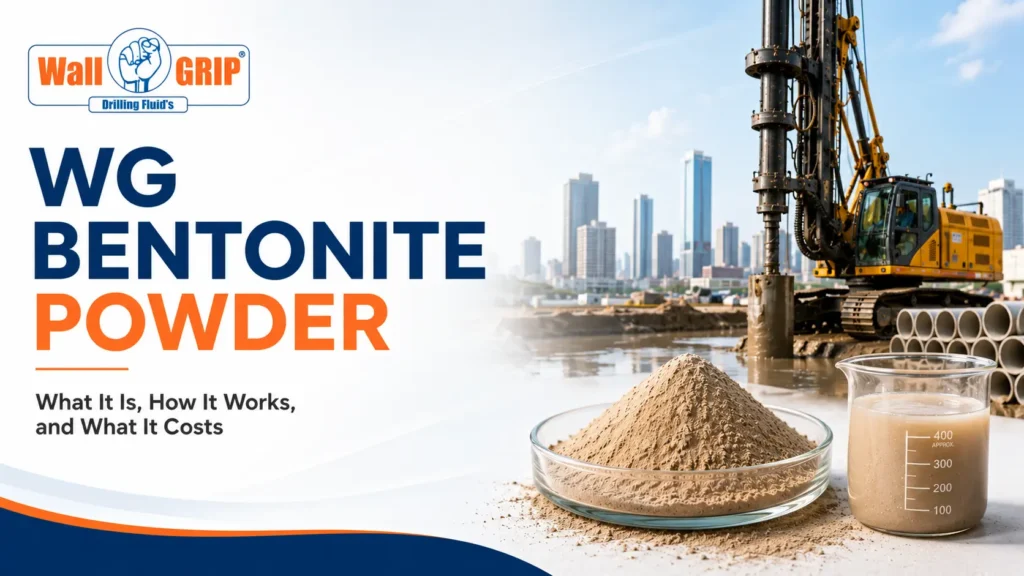
Bentonite powder is a natural clay mineral that swells when mixed with water, forming a thick, stable slurry used to support borehole walls during foundation drilling. In piling, it’s mixed with fresh water and pumped into the bore to prevent collapse while the pile is being drilled. Sodium bentonite is the grade used for piling and foundation works in India.
What is Bentonite Powder Made From?
Bentonite is a fine-grained clay formed mostly from montmorillonite, a mineral that’s unusually good at absorbing water. When it touches water, its structure lets it swell to many times its dry size, forming a thick gel instead of just dissolving. That swelling ability is the entire reason bentonite works for drilling, it’s not a chemical additive doing the job, it’s the clay’s own physical structure.
Why is Bentonite Used in Bored Pile Drilling?
When a hole is bored for a foundation pile, the surrounding soil pushes back, and in weak or loose ground, that pressure can cause the borehole to collapse before concrete is poured. Bentonite slurry counters this because it’s slightly denser than water, so it pushes back against the borehole wall and holds it open. It also coats the wall with a thin, low-permeability layer, meaning water struggles to pass through it, and this keeps drilled soil suspended in the fluid instead of settling and clogging the hole.
How Do You Mix Bentonite Slurry for Piling on Site?
Bentonite powder is added gradually to clean, fresh water under continuous mixing, to prevent the powder from clumping instead of dispersing evenly. WG Bentonite Powder is typically mixed at a working concentration and left to hydrate for 12 to 24 hours before use, since the slurry needs that time to reach full thickness and gel strength. Once mixed, it’s recirculated through a recovery system rather than mixed fresh for every pile, keeping the slurry desanded (filtered to remove collected soil) and reused as long as it still meets site requirements.
How Much Bentonite Powder Do You Need Per Cubic Meter of Water?
Standard construction practice runs bentonite powder at roughly 4-6% of the water’s weight for general piling slurry, though the exact figure depends on the soil conditions and the specific viscosity and density targets set for the project. This isn’t a fixed number, it’s a starting point that gets adjusted based on what the site testing actually shows.
What is the Difference Between Sodium Bentonite and Calcium Bentonite?
Sodium bentonite swells far more than calcium bentonite, often 12 to 15 times its dry volume compared to just 2 to 3 times for calcium bentonite. That difference is why sodium bentonite is the type used for piling and soil stabilization work, calcium bentonite simply doesn’t swell enough to hold a borehole open. Calcium bentonite is more commonly used in industries like cosmetics, animal feed, and foundry sand instead.
What Quality Checks Should I Run on Bentonite Before Using It on Site?
Four properties matter most on an active site: Marsh viscosity (how thick the slurry is, checked with a simple funnel test), pH, density, and sand content. These are typically checked before each pour cycle, not just once at the start, since slurry properties shift as it’s reused and picks up soil particles. WG Bentonite Powder is manufactured to conform to IS:6186, the Indian Standard covering bentonite quality.
Here’s what WG Bentonite Powder is tested against as raw material, straight from WallGrip’s own published technical data:
| Parameter | Typical Value |
| Appearance | Fine, free-flowing powder |
| Color | Light grey to cream |
| Montmorillonite Content | ≥ 85% |
| Moisture Content | ≤ 12% |
| Liquid Limit | ≥ 350% |
| Swelling Index | ≥ 24 ml/2g |
| pH (5% suspension) | 9.0–10.5 |
| Sand Content | ≤ 4% |
| Marsh Funnel Viscosity (6.5% w/w) | ≥ 35 sec/qt |
| Plastic Viscosity | ≥ 10 cP |
| Yield Point | ≥ 15 Pa |
| Filtrate Loss (API) | ≤ 15 ml / 30 min |
And here’s what should be monitored once the slurry is mixed and in use on an active site:
| Parameter | Recommended Range | Method / Note |
| Marsh Funnel Viscosity | 32–50 sec/qt | Before each pour |
| Density | 1.02–1.10 g/cm³ | Mud balance check |
| pH | 8.5–11.0 | pH meter or strips |
| Sand Content | < 4% | API sand content kit |
| Filtrate Loss | < 25 ml / 30 min | API filter press |
| Gel Strength (10 min) | ≥ 4 Pa | Viscometer reading |
Where Can I Source Piling Grade Bentonite Powder in India?
WallGrip supplies WG Bentonite Powder, a high-yield sodium bentonite manufactured to foundation grade, from its facility in Delhi, with pan-India supply coordination available based on project requirement and timeline. The company is ISO 9001:2015 certified.
FAQ
Question: What is bentonite powder used for in construction?
Answer: Mainly to stabilize boreholes during piling and deep foundation work, preventing trench and pile walls from collapsing before concrete is poured.
Question: How long does bentonite slurry need to hydrate before use?
Answer: Typically 12 to 24 hours, which allows the powder to fully swell and reach the gel strength needed for site use.
Question: Can bentonite slurry be reused across multiple piles?
Answer: Yes. On most sites, slurry is recovered, desanded, and recirculated rather than mixed fresh for every bore, as long as it still meets the required density, viscosity, and sand content limits.
Question: Is sodium bentonite the right choice for piling?
Answer: Yes. Sodium bentonite’s higher swelling capacity is what makes it suitable for drilling and soil stabilization, unlike calcium bentonite, which doesn’t swell enough for this use.
Looking for piling grade bentonite for your project? Request the TDS for WG Bentonite Powder to get the full technical specification sheet.