
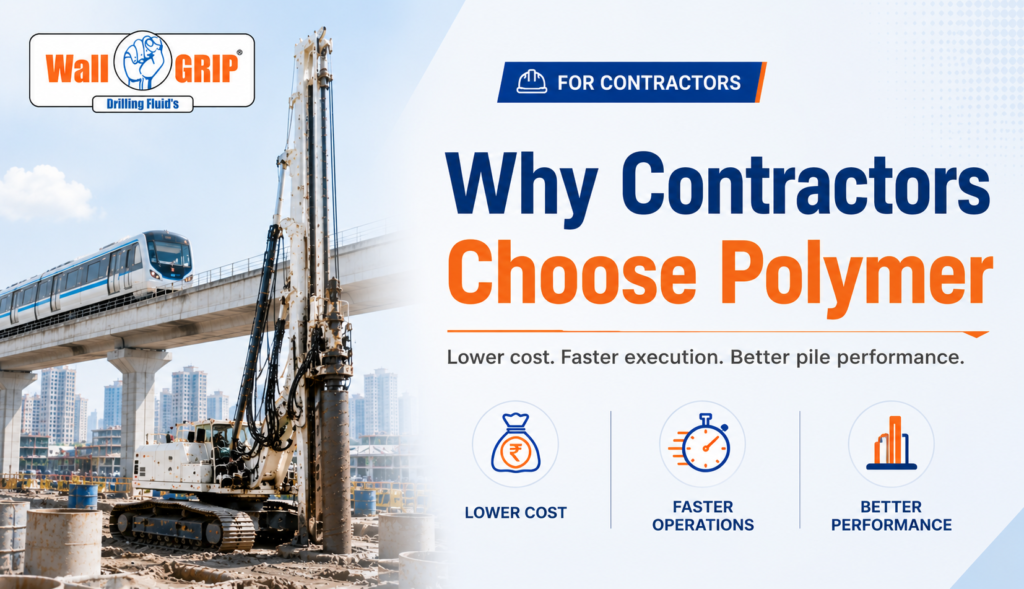
Metro projects in India are moving from bentonite to drilling polymer because polymer costs less to use, takes less time to prepare, produces less waste to dispose of, and leaves a cleaner borehole before concreting. That is the short answer. Here is what is behind each of those points.
Does polymer actually cost less than bentonite on a metro project?
Not on the bag. By weight, drilling polymer costs more than bentonite. But that is the wrong comparison.
Think about how much material you actually need. To stabilize the same borehole volume, polymer needs roughly one-tenth of the material by weight compared to bentonite. Less manpower handling bags.
Then there is recyclability. WG Drilling Polymer can be recirculated and reused many times on a long-running site. You are not buying fresh fluid for every bore. On a package running for months, the material you save through recycling is significant.
Then there is time. Bentonite needs around 24 hours of hydration before it reaches working viscosity. You mix it the evening before. Polymer is ready in minutes. On a metro piling programme with daily targets to hit, that saved preparation time on every shift adds up to real programme recovery.
Then there is disposal. Bentonite creates large volumes of thick mud that needs desanding equipment, chemical treatment, and significant manpower to remove from a congested urban site. Heritage Infraspace India Ltd, one of India’s major metro contractors, documented their switch from bentonite to polymer for diaphragm wall work specifically because disposal cost and environmental compliance on their urban sites became a problem. Polymer breaks down with a bleaching solution. No heavy equipment. No complex process.
So by weight, bentonite is cheaper. By project, polymer costs less.
Does polymer meet PSU and EPC project specifications?
Yes. But the supplier has to provide the right documentation.
NCRTC, NHSRCL, and DMRC specifications now regularly include polymer as an accepted or preferred drilling fluid for bored pile and diaphragm wall works. The shift has happened at the specification level. What decides whether your submission gets approved is whether your supplier can provide the documentation the quality team needs.
WallGrip India provides all of this as standard through an enquiry-first process. Share your project specification and the documentation pack is prepared to match it.
What about pile performance? Does polymer affect the pile?
Polymer-drilled piles consistently show better concrete-to-soil bond compared to bentonite-drilled piles where wall cake residue was not properly removed before concreting.
Here is why. Bentonite builds a physical filter cake on the borehole wall during drilling. That cake is what holds the ground back, which is useful. But before concreting, that cake is still sitting on the wall. Between the concrete and the soil. If it is not cleaned away properly, it reduces the bond between the pile and the surrounding ground. That reduces the pile’s load carrying capacity. Research published in geotechnical literature confirms this is the main performance concern with bentonite in bored piling.
Drilling Polymer does not build a permanent filter cake. The borehole wall before concreting is cleaner. The concrete bonds better with the soil. For metro foundation piles carrying heavy structural loads, that interface performance matters.
That said, the right choice between polymer and bentonite depends on your ground conditions, your consultant’s requirements, and your project specification. It is always site specific. If you are unsure which is right for your package, share the ground profile and specification with WallGrip’s team and they will give you a straight answer.
The short answer to this section’s question is: polymer does not reduce pile performance. On most metro ground conditions in India, it improves it.
For a complete breakdown of drilling polymer, including mixing, dosage, and site monitoring parameters, read:
What is Drilling Polymer and Why Do Piling Contractors Use It?