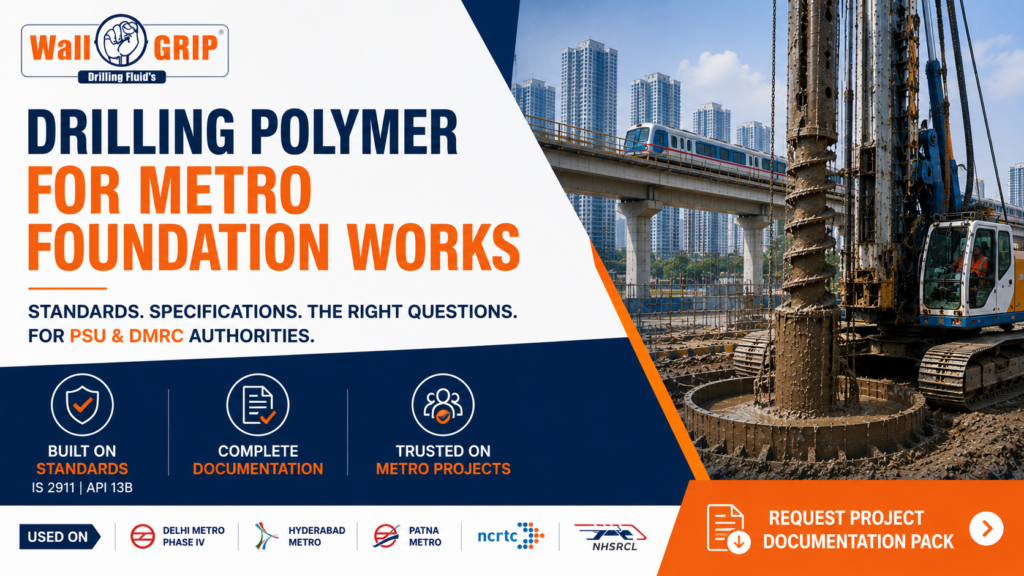
When a contractor submits a drilling polymer for approval on a metro foundation project, you need to know which standards apply, what documentation to ask for, and what signals a supplier is not up to the job. This covers all three.
What standards govern drilling polymer fluid for bored pile work in India?
Two references apply. IS 2911 and API 13B.
IS 2911 is the Indian Standard code of practice for design and construction of pile foundations. It is the primary reference for bored pile construction in India. When a contract specifies drilling fluid requirements, IS 2911 is the governing standard.
API 13B is an international standard that defines the field testing procedures for drilling fluids. API stands for American Petroleum Institute. Even though it comes from the oil and gas industry, the testing methods it defines for density, sand content, pH, and viscosity are widely adopted in civil geotechnical work because they are precise and repeatable. Metro project specifications including DMRC, NCRTC, and NHSRCL packages reference API 13B procedures for on-site quality checks.
Between the two, IS 2911 governs what the pile must achieve. API 13B governs how the fluid is tested. A compliant supplier should be familiar with both and able to demonstrate their product meets the parameters set in your project specification.
What documentation should a polymer supplier provide for PSU evaluation?
Six things. All of them should arrive without you having to chase.
A Technical Data Sheet covering product composition, performance parameters, mixing ratios, dosage guidance for different soil conditions, and shelf life.
A Material Safety Data Sheet covering handling, storage, disposal, and environmental impact.
ISO 9001:2015 certification. This covers quality management. It tells you the supplier has documented and audited processes for manufacturing and supply.
ISO 14001:2015 certification. This covers environmental management. On urban metro sites with disposal constraints and environmental monitoring, a supplier without this certification is a compliance risk.
Test certificates for viscosity, pH range, biodegradability, and marine toxicity.
Project references with contractor names, project titles, and contact details your quality team can cross-check against procurement records or public tender information.
All six should arrive quickly. A supplier who takes time to produce basic documentation is a supplier whose product has not been properly tested or certified.
What are the red flags when evaluating a polymer supplier?
Three things signal a supplier is not ready for a PSU or metro project.
Unverifiable project references. Any supplier can list project names on a brochure. References should include the contractor name, the package, and enough detail for your team to cross-check. If a supplier cannot provide that, the references are not worth anything.
No ISO 14001 certification. Bentonite disposal created environmental compliance problems on urban metro sites. That is one of the main reasons polymer gained traction. A polymer supplier without ISO 14001 certification has not been audited for its own environmental practices. That is a risk you should not take on a project with environmental monitoring requirements.
A single dosage recommendation for all conditions. Ground conditions on metro projects across Delhi, Mumbai, Bangalore, and Hyderabad vary significantly. A serious supplier gives you dosage guidance by soil type. From 1 kg per cubic meter for clay and low-permeability soils up to 2 kg per cubic meter for gravels and high-permeability formations. A supplier who gives you one number for everything has not done field work across varied ground.
WallGrip India supplies WG Drilling Polymer to metro projects including Delhi Metro Phase IV, Hyderabad Metro, Patna Metro, NCRTC, and NHSRCL. Other suppliers in this space include Chemtex Speciality Limited and Goldy Minerals, both of whom supply PHPA-based drilling polymer to construction and geotechnical projects across the country. The company holds ISO 9001:2015 and ISO 14001:2015 certifications. Complete documentation for PSU and EPC evaluation is provided as standard through an enquiry-first process.
When a contractor submits a polymer for your approval, you now know what to ask for, which standards apply, and what the red flags look like. That is what this was about.
For a full technical overview of drilling polymer including IS standards, API 13B parameters, and supplier documentation requirements, read:
What is Drilling Polymer and Why Do Piling Contractors Use It?