
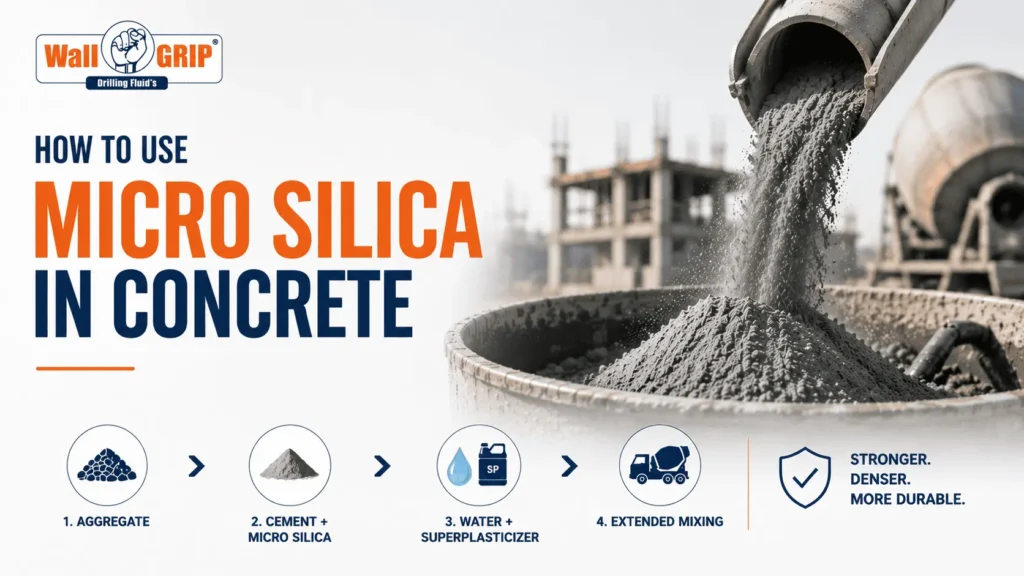
Micro silica is added to concrete at 5% to 10% of the cement’s weight, mixed in dry form directly at the batching plant alongside the cement and aggregate, and always paired with a superplasticizer to make up for the extra water it needs. The mix also needs to run about 20-25% longer than usual to fully mix in and spread out the ultra-fine particles. Get those four things right, and the rest is standard concrete practice.
How Much Micro Silica Should You Add to Concrete?
For general strength and durability improvement, 5% to 10% of cement weight is the standard range. For more demanding work, marine structures, aggressive chemical exposure, high-strength concrete above grade M50, dosage typically runs 8% to 10%. Some specialized mixes go up to 15%, but past that point the concrete becomes difficult to place without very careful redesign.
There’s also a strict legal limit worth knowing. Under IS 456:2000, Amendment No. 6 (Bureau of Indian Standards), silica fume combined with fly ash cannot exceed 35% of the total cementitious material by weight, with an additional 5% permitted only if the concrete’s water-cement ratio is below 0.40. In practice, most projects use far less than this limit for most applications, but it’s the real legal limit in India, not just a general guideline.
Industry sources report strength increases ranging from roughly 40% to 150%, depending on the dosage and mixing method used. That’s a wide range on purpose, and worth treating as a number from industry sources, not a single number checked by independent scientists. It tells you the ingredient works, but how well it works depends entirely on getting the mix design right, not just adding the powder and hoping.
Do You Mix It Dry or as a Slurry?
Both methods exist, but dry mixing has become the industry standard. Slurry form, where micro silica is pre-mixed with water before going into the batch, was common years ago because it made sure the material spread evenly. The problem is a practical one: slurry needs its own special mixing setup, and it only stays usable for about 30 to 40 minutes before it has to be used or discarded. Most batching plants now add micro silica in dry form straight into the mixer, alongside the cement, which skips that extra equipment and the tight time limit entirely.
What’s the Right Mixing Sequence?
A standard sequence looks like this:
- Load the coarse and fine aggregate into the mixer.
- Add the cement and micro silica together, and mix for about 30 seconds.
- Add the water and chemical admixture, then mix again until the batch is uniform.
- Extend total mixing time by roughly 20-25% longer than a standard concrete batch.
That last step matters more than it sounds like it should. One published study on dosing sequence found that simply changing the order in which micro silica was introduced improved accelerated curing test results by 5.95%, without changing how much of each material was used. That’s one specific test result, not a general claim about strength, but it makes the same point: the powder alone doesn’t do the work, how carefully it’s mixed in does.
Why Do You Need a Superplasticizer With Micro Silica?
Because of scale. Micro silica’s surface area is more than 15,000 square metres per kilogram, compared to just a few hundred for ordinary cement. That enormous surface area soaks up far more water than cement does on its own. Without a superplasticizer to keep the mix easy to work with, the natural instinct is to add more water. But that waters down the cement paste and cancels out the exact strength gain you added micro silica to get in the first place. A polycarboxylate-based superplasticizer (a common type of concrete additive) is the usual match for it, and above roughly 10% dosage, it’s no longer optional.
FAQs
Question: Can you use micro silica without a superplasticizer?
Answer: At very low dosage, under about 5%, it’s technically possible, but the mix becomes hard to work with fast, even at that level. Above 5%, a superplasticizer is standard practice, not an extra.
Question: Does micro silica change curing requirements?
Answer: The concrete itself doesn’t need a different cure time, but its surface dries faster than ordinary concrete, which raises the risk of small cracks forming as it dries (called plastic shrinkage cracking). Curing should start earlier and run a bit longer than usual as a result.
Question: Can you add too much micro silica?
Answer: Yes. Past 15% of cement weight, the mix becomes difficult to place and finish, and adding more no longer adds more strength. More isn’t better once you’re past the point your mix design can actually use.
Question: Is this the same process for shotcrete or marine concrete?
Answer: The core steps stay the same, dry dosing, superplasticizer, extended mixing, but the amount used and the additives chosen change for special uses. If you want the fundamentals on what micro silica actually is and why it works the way it does, we explain that in more detail in our main guide on micro silica.